Home
ArcIn AI
Login Request Demo Free Trial →
Platform · Capabilities

Slow query to root cause
in under 30 seconds.

You see slow database queries linked directly to the application services and code paths that issued them — automatically, without any database-side agents.

Start 14-day free trial → Book a live demo
<30s
Query-to-root-cause time
Product capability
100%
Query plans captured — no DB-side agents
Product capability
65%
DB-related incident reduction
Illustrative example
Figures above reflect measured product behavior and representative scenarios — not a guarantee of results in every environment.
Key capabilities

Database Monitoring.

🖹
Query performance intelligence
N+1 patterns, missing indexes, and lock contention surfaced with the exact ORM method that issued the query.
↓ 65% DB incidents · illustrative
🔗
Connection pool monitoring
Pool saturation detected before exhaustion. Leaks identified by service. Backed by actual workload patterns.
📊
Replication & HA health
Primary/replica lag, failover events — correlated with application read performance.
💸
Cost optimisation
Unused indexes, over-provisioned instances — rightsizing backed by 30-day actuals.
Applicare — Database Monitoring⬤ Live product UI
Slow Queries
14/hr
checkout-svc · N+1
Conn Pool
96%
orders-db · near limit
Repl Lag
Normal
0.8s · healthy
DB Cost
Over-prov.
3 instances
🧠 ArcIn: N+1 in checkout-svc: OrderRepository executing 47 SELECTs/request. Fix: eager load on order_items. Expected ↓340ms p99.
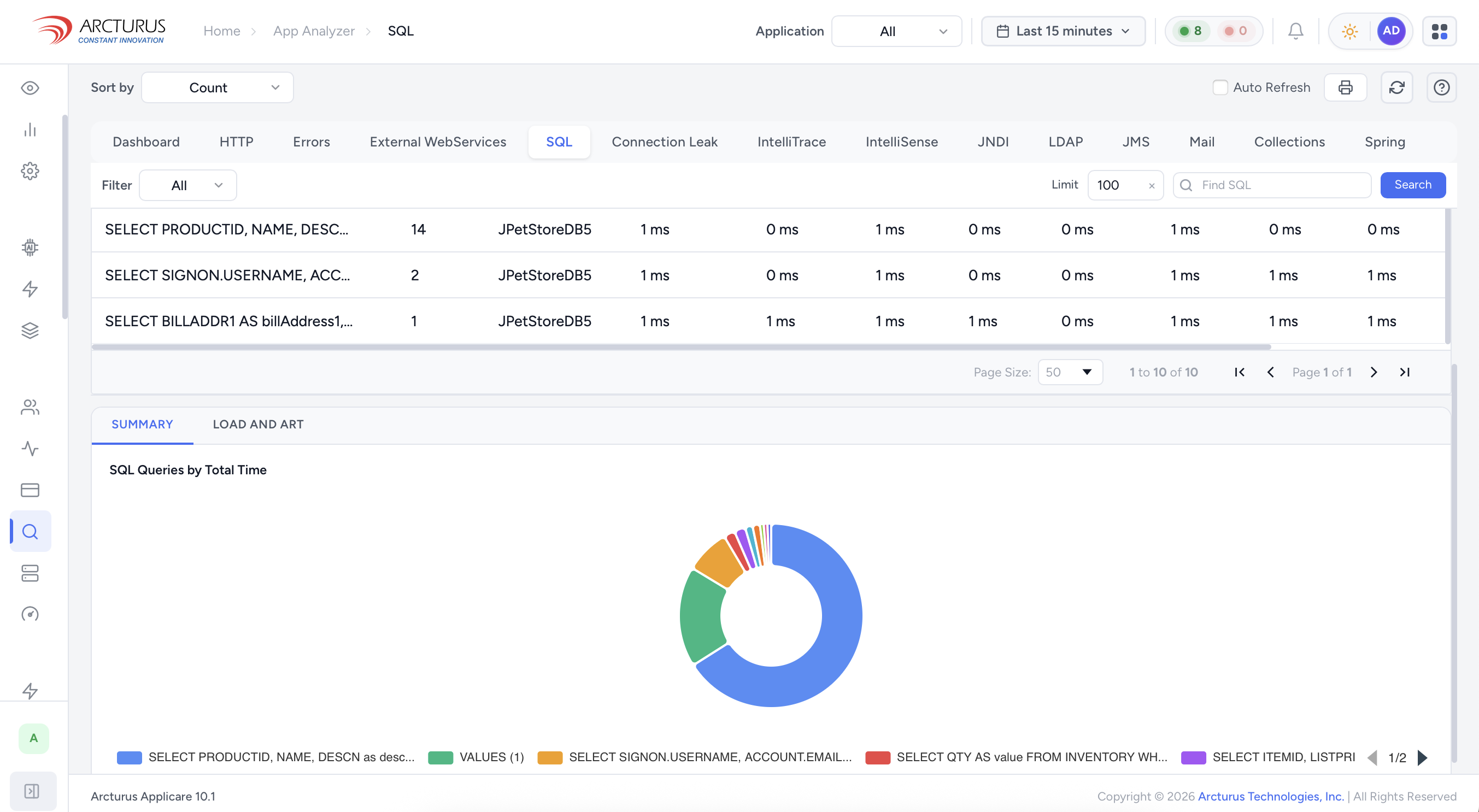
Database query intelligence — every SQL query tracked with response times and error counts
Demonstration data — illustrative environment, not a specific customer's metrics
The Core Differentiator

Not just "your database is slow."

Generic database monitoring stops at the query. Applicare keeps going — through the application service, the code path, and into a recommended fix.

1
Slow query detected
1.8s SELECT flagged on the orders table — above baseline for this endpoint.
orders-db
2
Database identified
Query traced to the specific table, index path, and wait event driving the latency.
Query plan captured
3
Application service linked
The query is mapped back to the exact service that issued it — no manual correlation.
checkout-svc
4
Code path pinpointed
The class and method responsible are surfaced, down to the ORM call site.
OrderRepository
5
Root cause & fix
ArcIn explains the likely cause in plain English and recommends a specific, reviewable fix.
ArcIn-assisted
Applicare in Action

Don't just find the slow query.
Find the code causing it.

A walkthrough of the N+1 example above, in the order an engineer would actually see it.

Symptom
47 SELECTs/request
checkout endpoint
Service
checkout-svc
order confirmation path
Code path
OrderRepository
N+1 query pattern
Recommended fix
Eager-load order_items
ArcIn-suggested
Expected impact
↓ 340ms p99
Illustrative example
This walkthrough illustrates how Applicare presents an N+1 pattern end-to-end. The 340ms figure is a representative scenario, not a measured customer outcome.
Applicare 10.0 — Live
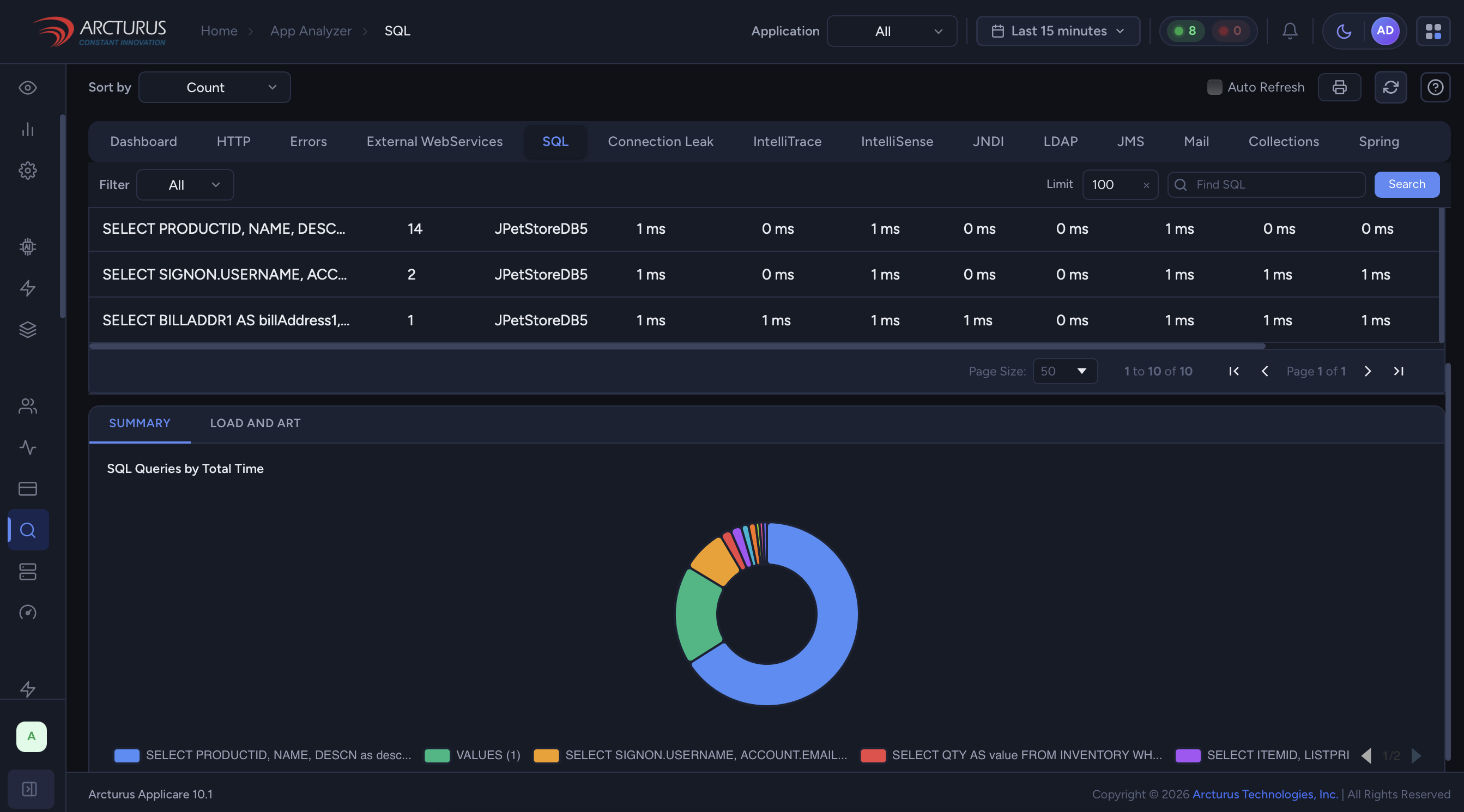
Applicare SQL Analyzer showing SQL query performance across JPetStoreDB

Applicare 10.0 — Top Business Transactions · SQL performance across JPetStoreDB

Full Database Monitoring coverage.

🐘
MySQL & PostgreSQL
Query plans, slow query log, replication health, InnoDB buffer pool.
🪸
Oracle & SQL Server
Wait event analysis, execution plan regression, tablespace and license utilisation.
🌿
MongoDB & NoSQL
Collection scan detection, index utilisation, oplog lag, shard balance.
Redis & Memcached
Hit rate, eviction, memory fragmentation correlated with application performance.
☁️
RDS & Aurora
Full cloud database monitoring with connection pool, replica lag, and cost attribution.
🔓
Query Attribution
Every slow query linked to the service, class, method, and git commit that issued it.
Why Applicare Database Monitoring?

Symptom vs. root cause.

Generic database monitoring tells you a query is slow. Applicare tells you why, and where to fix it.

CapabilityTraditional DB monitoringApplicare
Slow queriesShownShown
Database metricsShownShown
Wait events / locksShownShown
Link to application serviceManual investigation requiredCorrelated automatically
Responsible code pathNot identifiedClass and method surfaced
Database ↔ application correlationSeparate tools, separate viewsOne causal view
Root-cause reasoningEngineer interprets metrics aloneArcIn assists with plain-English analysis
Path to fixSymptom only — investigation is on youSymptom → cause → actionable fix
Real-World Use Cases

Where this shows up
in production.

🐢
Slow application response
Problem: Users report lag; the app tier looks healthy.
Detects: The specific query and service driving the delay.
Why it matters: Cuts triage from guesswork to a direct pointer.
🔒
Database contention / locking
Problem: Transactions queue behind locks during peak load.
Detects: Blocking sessions and the queries holding locks.
Why it matters: Contention is resolved before it cascades.
🔗
Connection pool exhaustion
Problem: A pool nears its limit and requests start failing.
Detects: Saturation trend and the service leaking connections.
Why it matters: Caught before exhaustion causes an outage.
☁️
Cloud database over-provisioning
Problem: Instances are sized for peak but run idle most days.
Detects: Actual utilisation vs. provisioned capacity, over time.
Why it matters: Rightsizing decisions backed by real usage.
See Database Monitoring live on your environment.
30 minutes. Read-only access. No prep required.